 The question is: “Are you in the danger zone?”
The feature song of the still popular movie, Top Gun, is Danger Zone. Flying an F-14 fighter, especially in combat, is certainly a venture into the danger zone. It’s also true that organizations and leaders trying to thrive or survive in an ever-changing world live in the danger zone all the time. So whether you like it or not, you’re there.
Zone One is things are going great—your organization (or you personally) is excelling, meeting all your goals, highly successful, maybe even the “big dog” in your business or niche (church, government, blogger or whatever). Are you in the danger zone? Yes. It is easer to get on top than stay on top and what got you there may not keep you there. “Big Dog” McDonald’s is learning this the hard way. After two years of declining sales, McDonald’s U.S.A. President, Mike Andres, has acknowledged that “What has worked for McDonald’s U.S. for the past decade is not sufficient to propel the business forward in the future.”
In Zone Two, you are “doing okay, things are stable, but could be better.” Is that a danger zone? Yes, because things never get better on their own. If nothing changes, nothing will change. Organizations in this zone are in danger of complacency and satisfaction squelching innovation and willingness to change. If you are stay long in this zone, you are in danger of sliding backwards into a rut (Zone Three). Customers and clients will move on; congregations will shrink; governments become bloated and dysfunctional; your health or your family will…. Well, you get the picture.
Zone Three is stuck in a rut—things are not going well, but you aren’t doing anything about it. You are stuck. One thing is sure: if you don’t change direction you’ll end up where you’re headed—deeper in the rut: your business will close; your church will become irrelevant; your health will get worse; your job will become obsolete due to technology; your marriage will end (that’s enough).
So you’re feeling that this isn’t exactly a Merry Christmas and Happy New Year kind of post. It can be. The end of—and beginning of—the year is a great time to decide you are going to do something so you don’t experience two more years of declining sales, more years of declining attendance, another year of gaining weight. You know which zone you’re in and what you need to do. Give yourself a Christmas present. Decide today—“I’m going to do it!” This could be the merriest Christmas and happiest New Year you’ve had in a long time.
By the way, on a personal note, I have found that it feels a lot less dangerous in the danger zone when I am not alone. That is the real meaning of Christmas—Immanuel means “God with us”—we don’t have to lead or live by ourselves. So I really do wish you a Merry Christmas and Happy New Year because God is with us!
If this post was interesting and useful, please forward it to a friend.
© Copyright 2014 by Dick Wells, The Hard Lessons Company
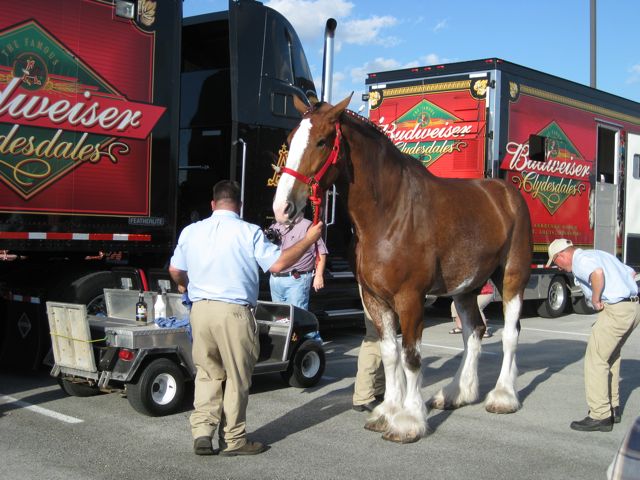 There isn’t much more traditional at Christmas time than the Budweiser wagon jingling its way through gently falling snow pulled by the magnificent Clydesdale horses They have never clopped their way up my street, but it must happen somewhere or they wouldn’t bother with the ads (or would they?).
Speaking of those ads, you’ll be seeing a lot less of them. It seems that the 20-somethings could care less about the Clydesdales and about Budweiser—almost half of them have never even tried a Bud. In the last ten years, Budweiser has lost half its market share; first to “light” beers (including Bud Light) and now to craft beers. Craft beer sales exceeded Budweiser’s for the first time in 2013. In an attempt to recoup younger customers, advertising dollars will move to food festivals, music festivals, and college town parties featuring Jay-Z, not the horses.
The leadership question in this is: what is “reality”? Are the Clydesdales not an effective marketing tool any longer, or has the market has moved on and the Bud advertising doesn’t matter much? This is something Budweiser needs to get right—but not just them. You need to get it right too. It is always leadership’s job to get “reality” right, whether you are talking about beer, computers, cars, or church.
Kodak couldn’t save film; Blackberry couldn’t save keyboard cell phones. I’m betting that the market has moved to light and craft and Jay-Z can’t save Budweiser. What do you think? Let me know in the comments block.
If this post was interesting and useful, please forward it to a friend.
© Copyright 2014, Dick Wells, The Hard Lessons Company
 High school students with good grades and good attendance need not apply for a job at Southwire’s Carrollton, GA, plant. Southwire is focused on helping those who are on the edge of dropping out and failing in life. They call it 12 for Life—finishing high school is the first step toward a better life.
From Forbes (August 18, The Dream Factory by Christopher Helman): “Since the launch of 12 for Life the district’s dropout rate has plunged from 35% to 22%. A total of 851 kids have graduated from the program…40% of whom have gone on to college.”
You can get the full story at http://goo.gl/xAp87p, but the short version is:
One of the keys to enduring greatness in any business is a purpose greater than profit. Southwire gets it. Now don’t be confused; they are a for-profit company with more than 7000 employees, 20 factories and $5B in sales. They manufacture wire, so they aren’t as glamorous as TOMS shoes and aren’t given shelf-space in Whole Foods. But along with profit, they are proactive in impacting their community for good (proactive meaning investing more than $3M to set up the 12 for Life program).
Southwire, founded in 1937, is owned by the Richards family of Carroll County, Georgia. What do you think they are most proud of? #1, we’ve made a lot of money; or #2, we’ve helped a lot of kids.
In your business and personal life, do you have a purpose greater than making money for yourself? If you don’t, follow Southwire’s example—get one!
If this post was interesting and useful, please forward it to a friend.
© Copyright 2014 by Dick Wells, The Hard Lessons Company.
 Most everyday, I start the day with a bowl of Cheerios or Shredded Wheat—great with some strawberries or a banana. Cheerios is a General Mills brand; the original Shredded Wheat is a Post product. Actually, I eat the Kroger store brand of each and per a 9/18/14 WSJ article, a lot of other people are also. (Stick with me; I’m getting to an important leadership point.)
In a recent AP interview, General Mills CEO Ken Powell said that Cheerios sales are “down somewhat” and in the WSJ article “blamed its marketing and promotions strategy for much of the disappointment….” Really? Sales are down because your ads aren’t effective? What could be more effective than a little girl serving Cheerios to her dad because it is good for his heart?
I asked Dottie why she buys Kroger Toasted Oats instead of General Mills Cheerios. Because it tastes better? No. Because you get more Kroger points? No. Because we own Kroger stock? No. (We don’t.) Because they don’t put toys in Cheerios anymore? No. The answer is simple: Cheerios are almost twice as expensive as Kroger Toasted Oats (26.6¢/oz. vs. 14.2¢/oz.). Now on the shelf, Cheerios only looks 50% more expensive because their nearly-same-size box contains only 12oz. vs. 14oz. in the Kroger box. (You have to look at the fine print to discover this little subterfuge.)
Max De Pree, retired CEO of Herman Miller says in Leadership Is An Art, “The first responsibility of a leader is to define reality.” The leadership at General Mills would benefit from reading De Pree’s book.
Here is the Cheerios reality as I see from a customer perspective:
Is your organization “down somewhat” in sales? Attendance? Donations? __________? The cure will start with an honest assessment of reality—no matter how painful. Cheerios first hit grocery shelves in 1941; for decades it was the choice of boys (including me) and girls all over America. No more. It’s time for General Mills to accept that fact. What fact do you need to accept?
If this post was interesting and useful, please forward it to friend.
© Copyright 2014 by Dick Wells, The Hard Lessons Company.
 If anyone understands how to do a Big Reveal, it’s Apple. Steve Jobs started it and current CEO Tim Cook has kept it going. I’m not sure who is involved in planning the Apple rollouts, but they know what they are doing. The September 9 rollout of the iPhone 6 and iWatch was the most anticipated tech event of the year and it did not disappoint. And, iPhone 6 sales are booming world-wide.
Big Reveals have not always been so successful. Before the days of brand experts, event professionals, and “everything sends a message” consultants, rollouts were planned by a secretary in the marketing department or the CEO’s golf buddy. That is what Ford must have done when they rolled out the Edsel in August 1957.
After months of buildup and anticipation, Ford invited 250 auto industry reporters (and their wives) to the Edsel Big Reveal in Detroit. So what happened?
Now I am not saying that the Edsel was a failure because of these faux pas, but the reporters and wives must have been laughing all the way home. If Facebook and Twitter had existed then, the whole nation would have been laughing by midnight. (Okay, you can stop laughing now.)
What is the leadership lesson in this? The “everything sends a message” principle is correct. Details matter and it is easy to overlook faux pas. Get help and have more than one set of eyes looking at every detail. Make sure that one of the “one set of eyes” is someone who was not involved in the planning and has a critical eye—someone who loves to point out goof-ups.
If the best hotel in town was the Cadillac, what was the message?
If this post was interesting and useful, please forward it to a friend.
© Copyright 2014 by Dick Wells, The Hard Lessons Company
 The founder of Chick-fil-A, S. Truett Cathy, died in his home last Monday at age 93. Starting in 1946 with a diner named the Dwarf Grill, Cathy built a chicken sandwich empire that today has more than 1800 restaurants and more than $5B in sales. There is a lot to learn about life and leadership from Truett Cathy whether you are leading a small business, church, or large corporation. Much of the Cathy story can be applied at home as well.
How do they do it?
Are you looking for a business model that will help get your endeavors back on track or spur growth? Try the Chick-fil-A way:
RIP, S. Truett Cathy. We have learned a lot from you.
If this post was interesting and useful, please forward it to a friend.
© Copyright 2014 by Dick Wells, The Hard Lessons Company
 Ernesto Sirolli—dubbed The Entrepreneurship Coach by strategy+business—tells this story about one of his early failures:
[We] decided to teach Zambians how to grow food in the beautiful fertile valley where they had always lived as pastoralists, shepherding animals but planting nothing. The team imported seeds from Italy—tomatoes and zucchini—but the locals didn’t seem interested. The team tried to pay them money, but there was little in the valley available to buy. Finally, the NGO started importing whiskey and beer in order to coax the men into the fields. “We kept thinking, what is wrong with these people?”
It soon became apparent. The tomatoes appeared on the vines, huge bursting fruits that put the most bountiful Italian crops to shame. The team members were joyful, but the next morning they awoke to find every single one of the plants gone. Hippos had swarmed up from the river and begun gorging. The Italians ran to tell the Zambians what had happened. “Of course,” said the people. “That’s why we don’t plant in the valley.”
“Why didn’t you tell us?” asked the Italians.
“Because you never asked,” came the response.1
I have made the same mistake many times. One of my notable failures was when I decided I could run a shipyard without knowing anything about building ships. FAIL.
The primary advice Sirolli gives business leaders is “Shut up and listen.”
That reminds me of one of my favorite, but too often ignored proverbs: “Even a fool is thought wise if he keeps silent….” (Proverbs 17:28 NIV)
Effective communication has a pattern:
Listen first;
Then ask questions;
Talk little.
I need to learn to take my own advice.
Dick, repeat after me:
Listen first;
Then ask questions;
Talk little.
Dick, repeat after me:
Listen first;
Then ask….
Dick, repeat after me:
Listen….
If this post was interesting and useful, please forward it to friend.
© Copyright 2014 by Dick Wells, The Hard Lessons Company
1 strategy+business, The Entrepreneurship Coach by Sally Helgesen, 1 August 2014
 It is a myth that home owning is always a good investment. It has been over long periods of time, but in the short term it works like the stock market—up and down. That has certainly been my experience. (Hang in here—I’ll get to the leadership point in a bit.)
Dottie (my wife) and I have bought and sold houses on seven occasions. I would like to say that we always made money, but on three occasions we didn’t. The primary variables have been how many years we owned the house; the housing economy; and the potential buyer/price ratio (how many buyers can afford the house). The details are:
#1 5 years Profit
#2 5 years Profit
#3 13 years Profit
#4 4 years Loss
#5 4 years Loss
#6 4 years Profit
#7 4 years Loss
#8 7 years Still own
One thing we have learned is that short stays (#4, #5 and #7) have a high risk of loss. The lesson is if you are a nomad (frequent moves for whatever reason), it is hard to build equity. Renting may be a better option.
#5 is a good example of the potential buyer/price ratio factor. The house was comparable to others in its small development (only twelve homes), but was too high for the community as a whole. There weren’t many potential buyers, so it was on the market for over a year and we lost a bundle.
#6 made a profit because the housing market got hot (2003-2006). However, the house we bought and are still live in (#8), lost about 10-15% of its value in the 2007-2011 housing crash, and is just now back to break even.
“Isn’t this supposed to be a leadership blog?” “Yes”—this post is about financial self-leadership, a much-avoided topic. If your personal finances are out of order and causing stress, it will affect your leadership whether at home, work, church, or wherever. So, the next time you are in the house market…
Any house buy/sell adventures you want to share? “Leave A Reply” below.
If this post was interesting and useful, please forward it to a friend.
© Copyright 2014 by Dick Wells, The Hard Lessons Company
 One of my daily rituals is to thumb through the WSJ—a venture that sometimes takes 10 minutes, sometimes an hour. It is much more than just business and geopolitical news. Today’s edition includes features about students building model bridges out of spaghetti, pessimism, toenail fungus, and Alabama coach Nick Saban.
One recent edition had an article about “mean bugs”—the stinging kind. Bees, wasps, hornets, and fire ants, all got some space, but yellow jackets are the most aggressive, sometimes chasing their victims out of pure meanness. Having been run down by a mad yellow jacket, I heartily agree. Dottie and I have also been chased by biting flies (in Maine) and have stepped on stinging scorpions (in Texas). According to the article, about “200 people in the U.S. die from stings every year” (Mean Bugs by Sumathi Reddy, WSJ, 7/15/14).
Sadly, a lot more deaths occur every day because of stinging tongues. According to James in the Bible, the tongue is a “restless evil…full of deadly poison” (James 3:8 NASB). The deadly poison of the tongue strikes everywhere: homes, businesses, churches, schools, and ___________ (you fill in the blank).
Morale is killed every day by stinging tongues. Initiative is snuffed out every day by critical tongues. Relationships are damaged every day by angry tongues. Lives are destroyed every day by gossiping tongues. I’ve been on the receiving end, and too often—especially at home—I’ve been the mean bug myself.
As a leader, one of your jobs is to set the guidelines—and the example—for the conversation that takes place in your organization. It’s up to you. You can allow an environment that discourages and tears down, or promote one that encourages and builds up. You can participate in gossip, or stop it. You can snap at everyone as a bully leader, or you can cut it off and insist on respect for everyone. One of my many hard lessons in leadership was allowing a chainsaw tongue to remain on my staff for too long.
You can spend a lot of money on training, consultants, seminars, or coaching, all trying to improve your work environment. How about trying bug spray that will eradicate stinging tongues? It is cheaper and much more effective. Spray yourself first, then….
If this post was interesting and useful, please share it with a friend.
© Copyright 2014 by Dick Wells, The Hard Lessons Company

I saw the ad on TV last week: Get a college degree and you’ll make twice as much as a high-school-only grad. I cringe every time I hear that because there is a lot more to the story than just getting a college degree.There are a lot of reasons people go to college—some are good reasons, some are not:
– Because your friends are going, you’ll have a good time, and a get a degree in something—a lousy reason to go.
– Because your parents want you to go—better, but not great.
– Because you want an broad-based education that will help you understand the world we live in—a good reason.
– Because you have a specific career you want to pursue (nursing, accounting, teaching, etc.)—a really good and necessary reason.
– Because you want to make twice as much money as high-school-only grads. You will probably need a college degree, but it matters a lot which degree because not any ol’ degree will do.
Thousands of people of all ages have tromped off to college, run up thousands of dollars of debt—which they are now drowning in—and are either under-employed or unemployed. The twice as much paradigm didn’t work for many of them.
What has happened? Driven by technology, globalization, and so on, the economic world has changed! You may not like the change, but it is a permanent fact of life. As a result, education is still an important factor in future income but you won’t make twice as much unless your degree is in demand, and what is in demand has changed a lot in the last ten to twenty years.
Some relevant facts from various sources are:
There are good reasons to go to college other than making twice as much. We need great teachers, godly preachers, skilled counselors, and so on. But few of those jobs make twice as much. So don’t pursue them for income, pursue them for impact—impact on our communities, churches, families….
So, what is the point of this?
Go to college? Yes. But do it for the right reasons, the right way, and with realistic expectations.
If this post was interesting and useful, please forward it to a friend—especially one who is considering college.
© Copyright 2014 by Dick Wells, The Hard Lessons Company.


The Hard Lessons Company
© 2014-2020
All rights reserved.
337 Whitewater Way
Franklin, TN 37064
615-519-3765