There are several “Best Places To Work” articles in business publications every year. Fortune magazine featured its “100 best” in the February 4th edition. The list includes all the usual suspects with Google as #1 for the 4th time. Technology, healthcare, consulting, service and similar companies dominate the various lists; coal mining, farming, and manufacturing aren’t much in vogue when it comes to “best places to work.”
Perks like onsite healthcare and recreation (Google has shuffleboard, basketball, horseshoe pits, etc.), high pay including 401K matching, flex time, sabbaticals, and lots of community involvement are tickets to making the lists. Who wouldn’t want to work for such companies?
But here is the hard truth: a company can offer all that and more and still be a lousy place to work if led and managed by “jerks.” Plante Moran, #25 on Fortune’s list, claims they are “relatively jerk-free.” My guess is they’ll stay on the list a long time if they remain jerk-free.
Nothing affects an employee’s workday—for good or bad—as much as the immediate supervisor/manager of the employee. People do not want to work for jerks—especially the best and brightest who can always find a job somewhere else with the same or better perks, but without the jerks.
Is morale low in your organization? Are you having trouble keeping the stars and “up-and-comers”? If either answer is “yes,” the problem may be too many jerks in leadership. Get rid of them. You can try reforming them, but it doesn’t often work. (Hopefully, the jerk isn’t you.)
Start today to transform your organization into a “jerk-free” zone. Maybe you’ll make the Forbes list someday.
If this post was interesting and useful, please pass it on.
© Copyright 2013 by Dick Wells, The Hard Lessons Company
One of my heroes in life, Ed Moody, passed a few weeks ago. Ed was one of the three or four finest men I have ever known (and I’ve been around long enough to know a lot of men). He is a legend here in Franklin (TN), and so is the business he started back in the ‘40s with his brother, Tom: Moody’s Tires.
At Moody’s, the focus is on serving people, not selling to customers. Ed has been known to replace a faulty tire he didn’t sell in the first place. Why? “People come back. Customers may not.” Tire rotation is free at Moody’s and they don’t ask whether you bought the tires there or not. Why? “People come back. Customers go shopping.” And I do. Year after year, for tires or whatever I need. Why? They treat me like a people, not like a customer.
So whatever you are doing in life, if you’ll focus on serving, not selling (tires or yourself), you have a great chance of being successful, maybe even for as long as the Moodys have.
By the way, the Moody Way continues as the store is now run by a second generation Moody, Jim, and a third generation Moody is waiting in the wings. I suspect they’ll be around serving people for another 60+ years.
[If this post was interesting and useful to you, please forward it to a friend. Thanks.]
© Copyright 2013 by Dick Wells, The Hard Lessons Company
“Prejudice…partiality…predisposition” are words used to define bias. Based on that, everyone is biased, including me…and you. The Weather Channel is too.
The Weather Channel (TWC) has what the WSJ (1/26-27/2013) calls “wet bias,” meaning that when the next day forecast is iffy, TWC will shade the forecast toward rain so we will be pleasantly surprised if the forecast is wrong. In fact, the next day’s weather will be better than forecasted about 50% more often than it will be worse than forecasted.
What does this have to do with life and leadership? Everything we hear from people in business (or at home or at church or wherever) is likely to have some bias in it. Most of us have a “bias set”: we are likely to be predisposed that it will rain (negative or glass half empty bias) or predisposed that it will be sunny (positive or glass half full bias). I tend a bit toward wet bias; my wife, Dottie, tends a bit toward sunny bias.
The life and leadership relevance is:
● Know your own bias
● Know the bias of those you receive input/advice from
● Don’t ignore input because of bias, just be aware of it
● Don’t label wet bias people as overly negative and don’t label sunny bias people as overly positive
Always remember that a 30% chance of rain tomorrow actually means there is a 70% chance it won’t rain. Plan your day accordingly; make sure you have an umbrella in the trunk, but don’t cancel the picnic.
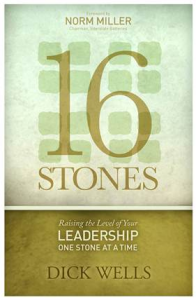
[By the way, I have a positive bias about my just released book, 16 Stones: Raising the Level of Your Leadership One Stone at a Time. Check it out at www.16stonesbook.com]
The catalyst for this post was a WSJ article by Carl Bialik, Some Percentages Are Just Fair-Weather Friends (26-27 January 2013).
If this post was interesting and useful, please forward it to friend.
© Copyright 2013 by Dick Wells, The Hard Lessons Company
Year after year, Southwest Airlines makes one or more of the various “Best Places To Work” lists. In some years (e.g., 2009), they are #1—THE best place to work.
In addition to being a great place to work, Southwest has been profitable for 40 consecutive years. Unlike all its major competitors, it has never filed for bankruptcy, and like all its major competitors, it is heavily unionized.
There are a lot of reasons for Southwest’s success: strategy, focus, execution, and so on. A big part of their success is a simple leadership philosophy that founder and chairman emeritus, Herb Kelleher, recently summarized in a Fortune interview:
(From Still Crazy After All These Years, Interview by Jennifer Reingold, Fortune, 1/14/2013. The next time you hanging in the airport news-stand, pick up Fortune; it’s always worth the price.)
It is unnecessary for me to add to what Kelleher had to say. All of us would be better leaders if we took his words to heart at work, home, church, wherever.
[If this post was interesting and significant to you, please forward it to a friend.]
© Copyright 2013 by Dick Wells, The Hard Lessons Company
Martin Luther King Jr. would make any thinking persons’ list of the top five 20th Century leaders in America. Who else would you put on the list? (Send in a comment and I’ll post it for everyone to see.)
Monday (1/21) is MLK Jr. Day. I will join in the celebration at Williamson College; millions more will observe the day all across the US. For African-Americans, MLK Jr. Day is more significant than July 4th—they were still slaves in 1776.
We tend to think of MLK Jr. in terms of the civil rights movement of the ‘60s—and well we should. But in this post, I want to remember him by sharing some of his thoughts about life in general.
I wish our politicians of all stripes were not guilty of…
MLK Jr.: Rarely do we find men who willingly engage in hard, solid thinking. There is an almost universal quest for easy answers and half-baked solutions. Nothing pains some people more than having to think.
Are you in a job that seems insignificant? It’s not!
MLK Jr.: All labor that uplifts humanity has dignity and importance and should be undertaken with painstaking excellence.
What are you most concerned about: how you live or how long you will live?
MLK Jr.: The quality, not the longevity, of one’s life is what is important.
Go ahead and do that thing that you have been putting of because it is hard.
MLK Jr.: We are faced with the fact, my friends, that tomorrow is today. Procrastination is still the thief of time.
Before you judge someone, make sure he has a pair of boots.
MLK Jr.: It’s all right to tell a man to lift himself by his own bootstraps, but it is cruel jest to say to a bootless man that he ought to lift himself by his own bootstraps.
There are about 38 million African-Americans who are distinctly better off because of the life of Martin Luther King Jr.; actually, all of us are distinctly better off because of the life of Martin Luther King Jr.
[If this post was interesting and significant to you, please forward it to a friend.]
© Copyright 2013 by Dick Wells, The Hard Lessons Company
Annabelle (picture) showed up on my daughter’s (Cathy) doorstep about 15 years ago. Minnie showed up on my other daughter’s (Elizabeth) doorstep last summer. Nuisance “turned up one day at our window, a little black cat with bowlegs and signs of the stress that spending too long outside alone can bring” (“our window” referring to the home of Gwyn Teatro).
If you have a cat, you know that the expression “herding cats” is an overstatement. You can’t herd even one cat. And the truth is, you can’t herd people either.
For the rest of Nuisance’s story and its parallels to relationships at home or in the workplace, read Gwen Teatro’s post at http://gwynteatro.wordpress.com/2012/12/23/four-leadership-reminders-from-nuisance-the-cat
Gwyn Teatro is always worth reading, and Nuisance’s story is both amusing (especially if you have ever been adopted by a cat) and thought provoking.
[If this post was interesting and useful to you, please forward it to a friend. Thanks.]
© Copyright 2013 by Dick Wells, The Hard Lessons Company
It was Monday; New Year’s Eve in Atlanta; the Chick-fil-A Bowl in the Georgia Dome; the SEC versus the ACC; LSU versus Clemson. And, it was a great game with a great finish. (Hang with me. In the end, this will not be about football.)
With 1:39 left in the game and LSU leading 24-22, Clemson got the ball at its own 20 yard line. The LSU fans fully expected their 7th ranked defense to hold; the Clemson fans were hopeful that their 9th ranked offense could move the ball far enough to kick a winning field goal. (Earlier, LSU had blocked an extra point, so even the most ardent Clemson fans were nervous, even doubtful.) Nobody was leaving.
97 seconds later, Chandler Catanzaro kicked a 37-yard field goal as time expired (yes, zero on the clock) to give Clemson a wild 25-24 victory. Quarterback Tajh Boyd had led the team on a ten-play, eighty-yard drive that included one 26 yard completion on a tension-filled 4th down. Wow, what an ending!
Was it luck? Was it a miracle? Was it mistakes by LSU? According to Quarterback Boyd, it was “none of the above”—it was preparation.
When asked in a post-game interview about the drive, Boyd’s response was, “I was confident because one of our drills in practice every Wednesday is what we’ll do with only 90 seconds left and eighty yards to go to win. We were prepared for this.” In other words, we play on Monday (or Saturday or Sunday or …), but we win on Wednesday by how we prepare.
There is an old adage that “success (or luck) happens when preparation meets opportunity.” So when Boyd walked onto the field with 99 seconds and 80 yards to go, he was prepared and confident. Arthur Ashe said it this way: “One important key to success is self-confidence. An important key to self-confidence is preparation.”
Whatever your game (business, ministry, education, government, other) and whatever your game day, you win on Wednesday—your preparation day. Relying on luck or miracles is a losing strategy. Preparation is a confidence-building winning strategy. So whether it is a sales call, sermon, board meeting, or football game, the long-time motto of the Boy Scouts applies: “Be prepared.”
I am leading a strategy session at a local college this morning (Thursday). I’m ready. Why? Can you guess how I spent Wednesday?
[If this post was interesting and useful to you, please forward it to a friend. Thanks.]
© Copyright 2013 by Dick Wells, The Hard Lessons Company
2013 is only four days away. Are you ready? Here are a few suggestions that will help you.
#1 Have no more than three personal goals for the year. Choose three things that are doable that will really make a difference in your life.
#2 Choose one goal that is primary—an “if-I-only-get one-thing-done” goal, this is it.
#3 Plan (something that can be measured) in detail for January through March. It is important to get off to a good start. In late March, plan for April through June, and so on.
#4 Make sure you have an accountability mechanism. Post your plan on the refrigerator (my way) or give it to a friend who won’t say “don’t worry about it” if you begin to slip.
Remember these principles:
Erwin McManus—“Living in the past is an enemy of the future.”
Don’t let past failures keep you from trying again.
Chinese Proverb—“If you don’t change direction, you’ll end up where you are headed.”
Nothing will change without change.
John Maxwell—“You don’t have to be great to start; but you have to start to be great.”
2013 is as good a time as any to start. Why wait?
Tom Landry—“Setting a goal is not the main thing. It is deciding how you will go about achieving it and staying with that plan.”
It won’t just happen. You need a plan.
Best wishes for a great 2013. I’m pulling for you to hit the mark—dead center!
[If this post was interesting and useful to you, please forward it to a friend. Thanks.]
© Copyright 2012 by Dick Wells, The Hard Lessons Company
Many of you have just 12 days working days left this year (12/11, 12, 13, 14, 17, 18, 19, 20, 21, 26, 27, 28).
If you are in retail, things are probably crazy for you (I hope so), but for many of you it is a time when things slow down a bit—clients are out a lot; there is a leave-it-until-next-year attitude about work; lots of office parties; and so on.
It is a good time to relax and enjoy the season; however, it is also a good time to get ready for 2013.
Here are 12 suggestions, in no particular order, which will help you get a good start next year without wearing you out this year:
If all 12 don’t apply to you, substitute something that does. The point is, it’s okay to slow down, but don’t come to a dead stop. Don’t start 2013 with “I wish I had…”
[If this post was interesting and useful to you, please forward it to a friend. Thanks.]
© Copyright 2012 by Dick Wells, The Hard Lessons Company
The commander of the U. S. Third Army in WWII, General George Patton, is credited with originating the phrase pressure makes diamonds.
Robert Griffin III, the star rookie quarterback for the Washington Redskins, wears a T-shirt that says, “NO PRESSURE, NO DIAMONDS.” (He shines like a diamond when the pressure is on; his “diamond play” beat the Giants last night.)
While it’s true that pressure makes diamonds, it’s also true that pressure makes coal. And in fact, it makes a lot more coal than diamonds. That is why diamonds cost a lot more than coal. A one pound diamond is worth anywhere from $2-6M depending on its grade. A pound of coal is worth a few pennies.
Paradoxically, though diamonds cost more than coal, coal is more valuable. I can image a world without diamonds, but a world without coal? Almost half of our electricity comes from coal. Coal is central to steel making and the chemical industry, and thousands still heat their homes with coal. If the world runs out of one, I hope it’s diamonds.
All organizations have both coal and diamonds, and need both.
The diamonds are easy to spot: they shine, attract a crowd (fill the stadium seats or worship centers), get the endorsements and applause, and make big plays that are crucial to winning.
The coal is less glamorous and less visible, but just as important.
The Alabama offensive line is the team’s coal (ask the running backs how important they are).
Nursery workers are a church’s coal. (Imagine listening to the sermon with fifteen babies crying in unison.)
In publishing, editors are the coal. The UPS drivers are coal; maintenance workers are coal; the sound board technician is the concert’s coal; well…you get the idea.
One of the challenges of leadership is meshing coal and diamonds into a winning team. It starts with the recognition that the diamonds may cost more, but the coal is just as—maybe even more—valuable.
Why don’t you take a few minutes to let your coal shine in your spotlight? The diamonds already get enough attention.
[If this post was interesting and useful to you, please forward it to a friend. Thanks.]
© Copyright 2012 by Dick Wells, The Hard Lessons Company


The Hard Lessons Company
© 2014-2020
All rights reserved.
337 Whitewater Way
Franklin, TN 37064
615-519-3765